


Dance Spirit: What Survived Us
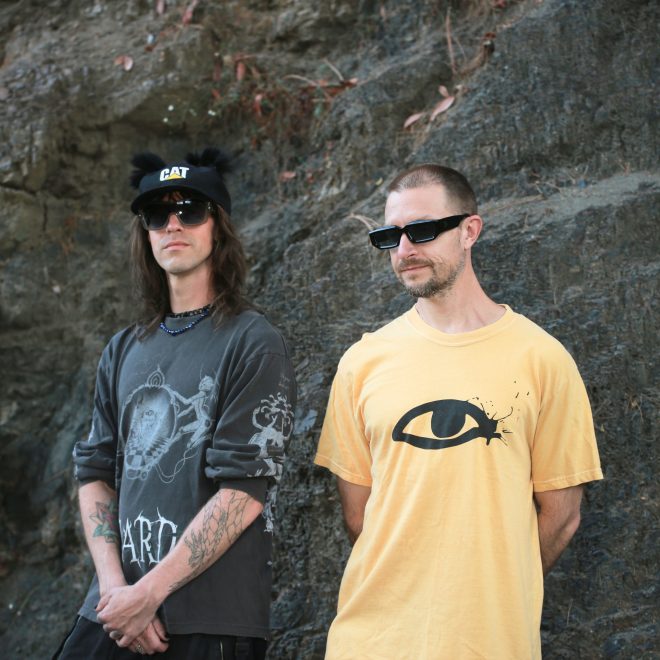
Six years after walking away from each other, Christopher Mohn and Reagan Denius are releasing the album they left behind. With Lunatic finally seeing daylight, Dance Spirit talk burnout, friendship, survival, finished music, and why reopening the past has unexpectedly put them back in the studio.
Six years is enough for an electronic record to betray the moment that made it. Production habits change, scenes reorganise, and musicians become strangers to earlier versions of themselves. Dance Spirit’s Lunatic spent that time finished, unreleased, and attached to a partnership that no longer existed. Christopher Mohn and Reagan Denius completed the 11-track follow-up to The Sun Also Rises before burnout and a personal rupture brought Dance Spirit to an end.
“When a song is done, a song is done. You just know it,” says Denius, also known as Robotek. “You can listen to it a week later, a month later, years later, and you don’t think, ‘Maybe I could add this embellishment, redo this fill into the break, sing this line differently or play this melody another way.’ It just didn’t need to be touched.” Built in their Los Angeles studio around modular synthesis, the Elektron RYTM, and a physical approach to sound design, Lunatic could easily have been dragged towards the present. Neither member heard dated technology or embarrassing decisions. Mohn agrees: “I didn’t really hear anything that I wanted to change. I think the music is timeless, the electronics that we used are timeless, and we had already signed off on the album.”
Leaving it alone also preserved its authors. “Preserving the earlier versions of ourselves was more meaningful than updating it because the album was already completed,” Mohn says. “All the content was there, and we were pretty much ready to go before we broke up.” Instead of correcting those people from the present, Dance Spirit have allowed them to remain audible. “In a lot of ways, it’s almost like we are picking up where we left off,” Mohn continues, “but at the same time we are trying to figure out who we are to each other now.” The album stayed fixed. Their relationship did not.
Before Dance Spirit separated, Mohn and Denius spent years working at a pace where work, friendship, and ordinary life blurred. There was constant touring, excessive studio time, two years producing Space Cadet magazine and the parties around it, all without much external structure telling them when to stop. “We were both really burned out,” Mohn says. “We didn’t have any management to tell us to put on the brakes, to let things breathe, to just let our work sit idle for a while.” They had grown up together inside the same creative relationship until, as Mohn puts it, “the boundaries of individuality were very blurred.” Eventually the intimacy that had sustained the project began working against it. “Reagan and I got so close for so long that we imploded past each other’s event horizon and became black holes to the other.”
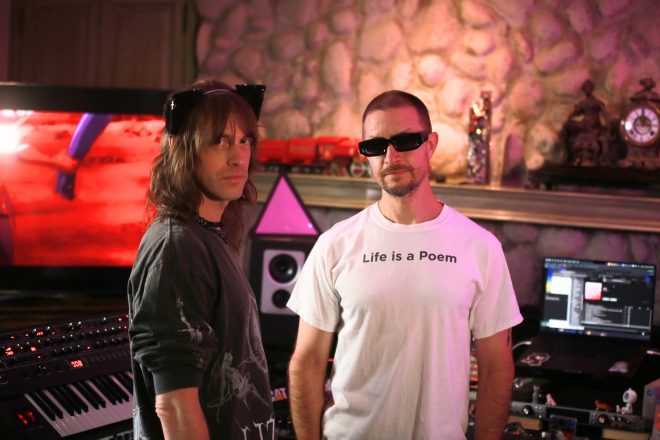
Denius does not soften his part in the collapse. “Of course, it’s a bit dramatic how it all went down, and the incident that spurred that was definitely my fault,” he says. “I think it had all been building up for a while, and I just created the catalyst for things to boil over.” He talks openly about the “immaturity and ignorance and impulsiveness” behind his actions, while also recognising that the rupture forced both men to become separate people. “There was a lot of personal growth that needed to take place in both of us, and I don’t think it would have happened if we had never gone separate ways.”
That history makes Lunatic difficult to hear simply as a delayed second album. Denius describes listening now as having a floodgate opened, with years of shared experience rushing back through the music. “As much as the album is a sample of the past, to me it still represents the future,” he says. “All those feelings are naturally encoded in the music. Certain songs take me back to moments they were made, and other times I can’t even remember making it.” Mohn remembers the tensions surrounding the period, but says the music itself rarely became the battleground. “Musically there was never really any friction between us,” he says. “We could always come together and make really good music without attacking each other.”
The title Lunatic grew from an attraction to people who refuse ordinary patterns: freaks, creators, dreamers, outsiders, revolutionaries. But the romantic image of the outsider was complicated by dance music culture, where freedom and self-destruction can blur after enough hours in the dark. Mohn remembers specific people feeding into the lyrics, including the line “when it’s light you fade away”. “I was exploring the lyrics through these people, and the amount of self-destruction and escapism that gets blended with community and pleasure and attention,” he says, “and all the smoke and mirrors inside and outside of the DJ booth.”
More than a decade later, Mohn’s understanding of rebellion has almost inverted. “In a world full of rebels and outsiders I feel even more rebellious because I am way less hedonistic and impulsive than ever,” he says. Age has not pushed him away from dance music; it has changed what he goes there to find. “At this point I’m realizing that music is a spiritual thing for me, and it’s my church. It’s how I meditate, recharge, socialize and reconnect with something bigger and deeper than myself.” Then comes the line that condenses that evolution: “Music is the voice of God and dancing is how we get to talk back.”
Denius receives the lyrics through his own history. He remembers contributing, or at least adapting while singing, one line in particular: “The love of life must persist.” During severe burnout at the end of 2019, Denius says the idea became something he could hold onto while fighting suicidal thinking. “Instead of resorting to ‘I want to die,’ I kept repeating that to myself,” he says. “I invented a mantra at the time to prevent myself from going there: ‘I don’t wanna die, but I don’t want this.’” What followed was not an immediate recovery but months of extreme apathy. Eventually, he says, “It turned into not wanting the apathy any longer, and ultimately brought me through.”
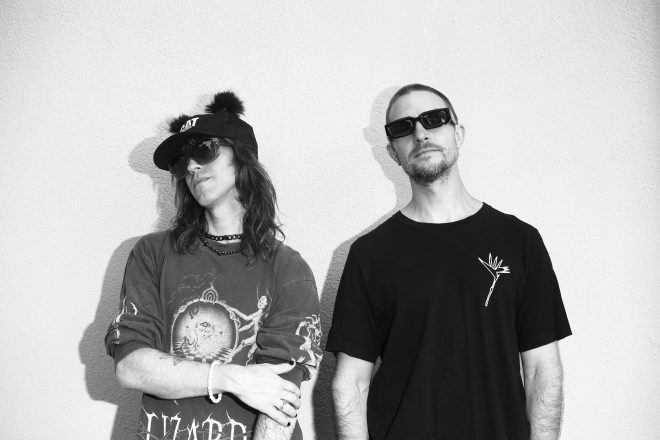
That movement between beauty and ugliness, light and darkness, pleasure and consequence shaped Lunatic. The album was never conceived as a bundle of dancefloor singles. Mohn points to Pink Floyd as an early reference, less sonically than in the belief that an album could construct a journey. “We’ve always strived to make our sets, our albums, and even our music journeys,” he says. “We wanted to make it a journey, not just a bunch of dance singles that you’re going to call an album.”
For Denius, that instinct reaches beyond Dance Spirit. Even his solo work required imagining a wider science-fiction world that the music could inhabit. Concepts are not decoration for him; they create room for questions conventional dance music language tends to avoid. “I feel like intelligent and abstract concepts allow you to explore themes and the human psyche and ‘why are we here’ more deeply,” he says. “I’m a dreamer, and a rebel, and I want to evoke raw emotion about both the beauty and ugliness, light and darkness, the dual oppositions in motion in this world.”
The record’s visual language follows the same instinct. Each of its 11 compositions has an original visual work by longtime collaborator Purdy Lites, an artist Mohn regards as almost another member of Dance Spirit. “He’s brought so much to the project in the past,” Mohn says. “His work is amazing, different, and really helps give the album a full-circle feel that the music alone couldn’t accomplish.” Mohn created the album artwork himself, while a fully mixed audiovisual edition pushes Lunatic further away from the idea of an album as sound alone.
Denius’s relationship with that visual language begins much earlier. As a child, he would stare into textured ceilings and walls, watching shapes emerge from random noise. “My parents would always catch me staring off into space and get worried,” he remembers. Surrealism, abstraction, and the glitch aesthetic later gave that instinct a vocabulary. “When you add music to pattern discovery, it creates a new pathway in the brain, at least for myself,” he says. “The two resonate with each other, and then any time you experience that object or pattern in the world again, the sonic tie will be recalled, and you’ll experience the music in your head suddenly.”
Six years later, that concern with resonance has acquired another form. Lunatic will arrive through Koukan, Dance Spirit’s independent imprint, whose name refers to the Japanese idea of sympathetic resonance. Initially, restarting the project was almost administrative: there was unreleased Dance Spirit music sitting behind them, and both men wanted it to exist outside their hard drives. “We both decided to start this up because we have such a huge body of work that we can still release,” Mohn says. “We just decided to start it back up again to see what would happen.”
"The friendship began returning alongside the music. “It’s neat to see that there’s still a friendship and a connection beyond the pain we caused each other in the past,” Mohn says. Denius describes the same shift from a slightly different angle. “We both agreed this was just to get our old music out,” he says. “Then, over the last few months, it started to feel more real now that we’ve reconnected and begun planning.”
Then they went back into the studio. Two older tracks received new mixdowns; two others opened further, accumulating new elements with the benefit of feedback DJ Three had given them over the years. It was a small but meaningful breach in the original agreement to release what already existed. “We’re even getting excited in talking about breaking ground on new songs instead of just updating old ones,” Mohn says. Denius feels the same movement: “We’re really excited to be creating together again.”
“We’ve rekindled a friendship as newer versions of ourselves, which are vastly different from our childhood, you could say,” Mohn says. The differences that once became difficult to hold inside such an intense relationship may now be what keeps it viable. “I’m noticing that our differences are our newfound strength, and that if we can lean into them and balance each other out, this project’s going to have an interesting future.” His conditions for continuing are strikingly ordinary: keep it about music, beauty, and connecting people; be good to each other. What began as two former collaborators clearing old work from the vault has turned into the question of whether Dance Spirit can exist without repeating the conditions that destroyed it.
There is an easy version of this story where Lunatic becomes evidence that everything happened for a reason, six difficult years collapse into redemption, and two friends discover that nothing essential between them ever changed. Their own account refuses that convenience. They did change. The album did not.
Lunatic arrives on September 25 carrying those earlier versions of Christopher Mohn and Reagan Denius intact. Its machines remain where they left them, its production decisions have not been rewritten to satisfy 2026, and its contradictions still refuse to settle. The people releasing it have had to learn how to meet each other again from a greater distance. They returned because there was old music waiting to be heard. Somewhere between listening back, standing beside each other again, and opening those studio sessions, the archive stopped behaving like an archive.
Catch Dance Spirit in Los Angeles this Friday, September 25 at Bar Franca for the Lunatic album launch party, followed by the DISTRIKT fundraiser on Saturday, October 3.
